In-Cabin Occupant State Perception
Active development — dual-head seat-occupancy and occupant-posture classification from fisheye cabin imagery, with leakage-resistant data splits and a deployable ONNX contract
As sole technical owner, I am taking an end-to-end visual perception system for per-seat occupant state understanding from initial requirements through active model development, validation, and production-interface integration. The current dual-head baseline jointly classifies seat occupancy and occupant posture—including forward-leaning, upright, and reclined states—while the surrounding engineering work turns raw recording sessions into reproducible supervision, separates evaluation sessions from training data, and maintains a stable interface for downstream integration.
Because the project is still active, this page emphasizes the technical contract and engineering decisions rather than publishing provisional headline accuracy.
Fisheye imagery, occlusion, posture variation, class imbalance, and temporally correlated recordings make apparently simple classification difficult to evaluate honestly.
Version fixed regions of interest, isolate recording sessions, share visual features across seats, and couple model quality with deterministic data and evaluation checks.
Expand label coverage, freeze the evaluation protocol, test failure modes across seeds, and validate the exported model contract before reporting final results.
Problem & operating context
An occupant-monitoring model must convert wide-angle cabin imagery into a stable state estimate for each defined seat. The hard part is not only recognizing people. A usable system must preserve seat identity, avoid temporal leakage between train and validation data, remain interpretable under class imbalance, and expose predictable outputs to the consuming software stack.
The project therefore treats data construction, model behavior, evaluation, and integration as one system rather than optimizing an isolated image classifier.
System architecture
Turn correlated recordings into trustworthy supervision
- Defined a seat-centric label schema that keeps occupancy and occupant posture explicit instead of hiding application semantics inside folder names or preprocessing code.
- Built deterministic sample manifests from recording sessions, with fixed seat regions and reproducible mapping from frame metadata to model inputs.
- Used session-isolated splits so visually adjacent frames from the same recording burst cannot inflate held-out performance.
- Designed burst-aware sampling and dataset audits to expose duplicate frames, sparse labels, class skew, missing files, and inconsistent annotations before training.
- Kept preprocessing configuration versioned so the same crop geometry and normalization contract can be reproduced during evaluation and export.
Share perception while preserving seat-level outputs
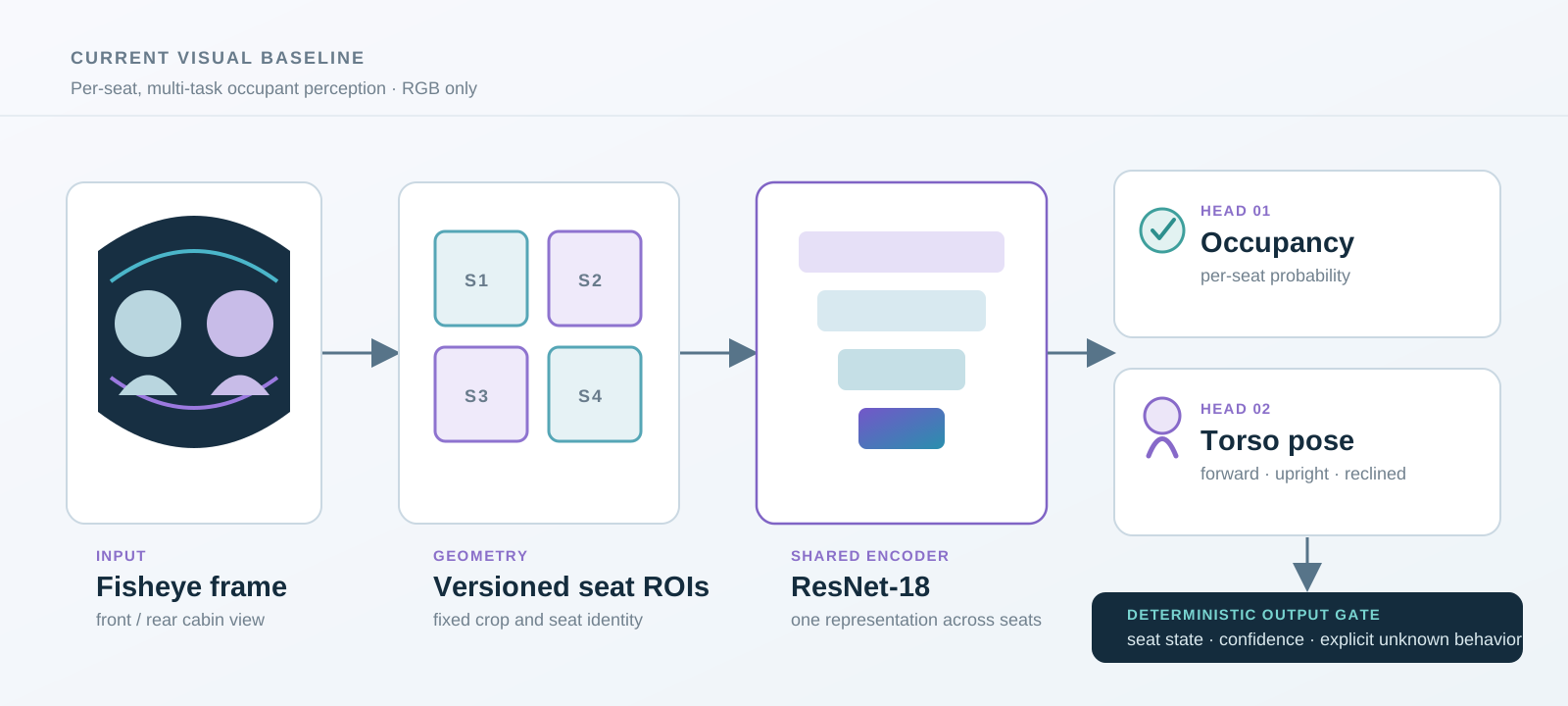
The current visual baseline crops each configured seat region from a fisheye frame and passes every crop through a shared ResNet-18 encoder. Two task heads operate on the same representation: a binary occupancy head and a three-class posture-classification head for forward-leaning, upright, and reclined states. Deterministic output gating prevents an unoccupied seat from producing a semantically misleading posture prediction.
For seat region (s), the model can be summarized as
The posture objective is meaningful only for occupied seats. Making this dependency explicit keeps the training target and downstream output semantics aligned.
Make experiments repeatable, not anecdotal
- Centralized dataset, augmentation, optimizer, schedule, seed, and checkpoint configuration so experiments can be reconstructed from artifacts rather than memory.
- Added deterministic execution controls and multi-seed runs to distinguish architecture changes from initialization noise.
- Tracked task-specific losses and class behavior separately, preventing a strong aggregate number from masking a collapsed occupancy or posture class.
- Preserved best-checkpoint selection and export metadata as part of the experiment contract.
- Structured the repository around data preparation, training, evaluation, and export boundaries so changes can be audited without tracing an ad hoc notebook workflow.
Test the failure modes that matter operationally
The evaluation plan goes beyond aggregate accuracy. It reports per-task confusion matrices and per-class behavior, checks whether every class is actually predicted, and separates directional occupancy errors because a missed occupant and a false occupied seat have different operational consequences.
Session-held-out evaluation, multi-seed variation, degeneration checks, and label-quality audits are treated as release gates. Final quantitative results will be published only after the dataset and evaluation contract are frozen.
Design for integration from the beginning
The baseline is exportable through PyTorch → ONNX with a documented tensor contract for preprocessing, seat ordering, occupancy probability, posture probabilities, and deterministic gating. This boundary is intentionally narrow: the learned model estimates visual state, while seat configuration, policy thresholds, and application-specific decisions remain explicit in the consuming system.
Current integration work focuses on numerical parity, stable input shapes, reproducible preprocessing, and clear failure behavior when inputs or configuration violate the expected contract.
Freeze the evidence before publishing the result
The next milestones are to expand and audit label coverage, finalize the held-out session set, complete multi-seed comparison of the visual baselines, validate upstream frame and ROI assumptions, and lock the exported interface. Once those contracts are stable, this page can graduate from an active research case study to a result-led project with defensible headline metrics.
Technology
Python · PyTorch · ResNet · OpenCV · Fisheye Vision · Multi-Task Learning · Experiment Tracking · ONNX · Reproducible Evaluation
SELECTED WORKReturn to the complete project portfolioView all projects →
Architecture and workflow are summarized at a high level. No proprietary cabin imagery, customer data, vehicle counts, hardware identifiers, or unpublished performance values are shown.